
To teach a dog to drop it, begin with a safe toy the dog can comfortably give up, reward the release, and add the cue once the exchange is predictable. A slipper disappearing around the sofa is a poor first lesson. Set up the skill during quiet play, before you need it with something that matters.
This guide is for dogs who remain relaxed around people and their toys. If your dog stiffens, growls, snaps, or has bitten over an object, skip the exercises and seek qualified help. A release cue is useful, but it is not a treatment plan for resource guarding or a guarantee against swallowing something dangerous.
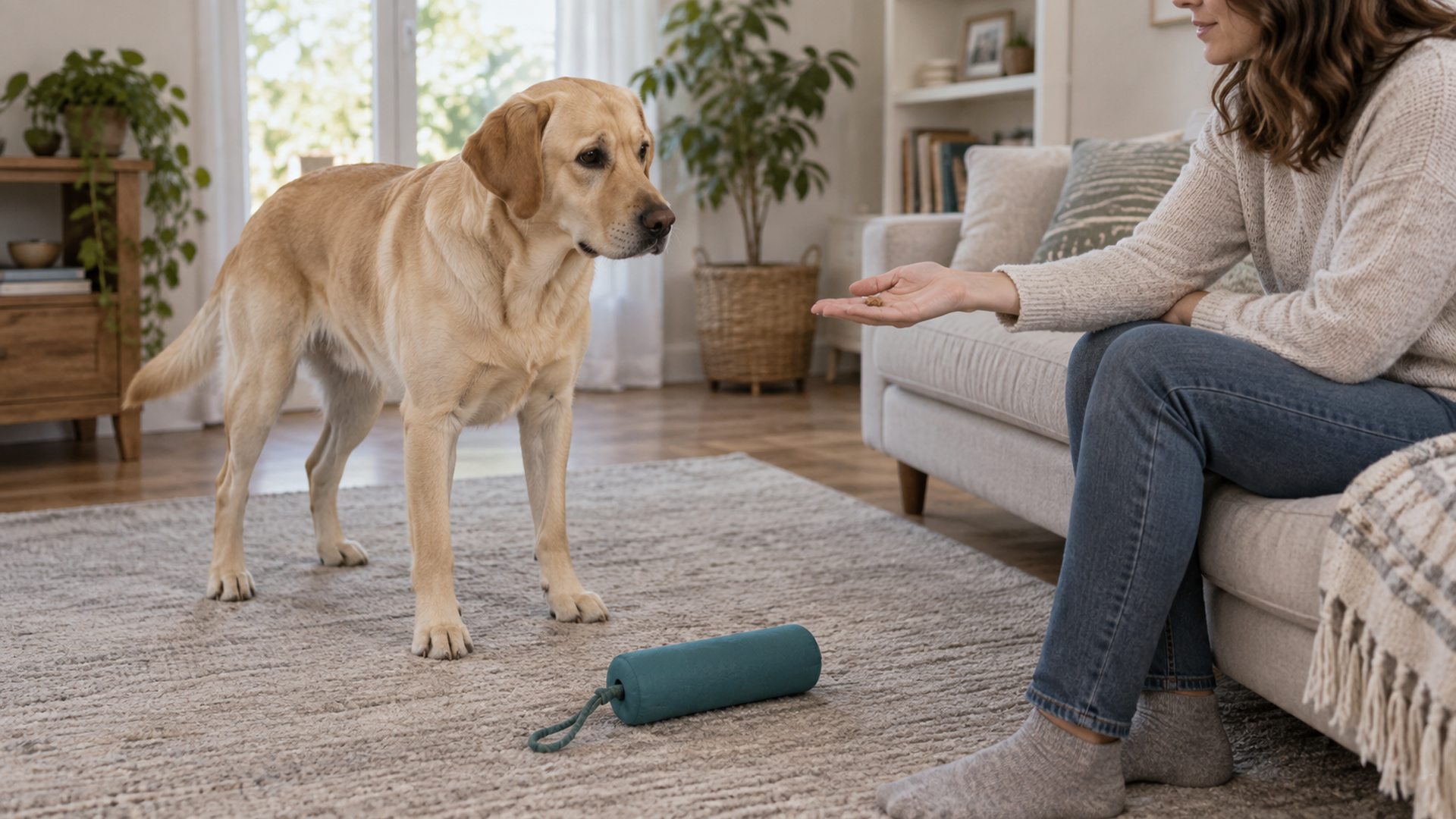
Drop It Quick Facts
| Question | Practical answer |
|---|---|
| What does the cue mean? | Release the object already in the mouth |
| What should practice start with? | A safe, moderately interesting dog toy in a quiet room |
| What counts as success? | A voluntary release with relaxed behavior |
| Does releasing include waiting? | No; collecting the toy adds another challenge |
| What ends the session? | Discomfort, guarding, or rising excitement that makes practice difficult |
| What still needs management? | Laundry, rubbish, medication, children’s toys, and other accessible hazards |
For broader household expectations, see our Labrador Retriever guide and Golden Retriever guide. A breed’s retrieving history does not mean an individual dog arrives knowing how to surrender an object.
Set Up a Trade the Dog Can Manage
Choose a quiet room, one adult, and an intact toy sized for your dog. Put other pets elsewhere and keep children out of the exercise. Lay out rewards before inviting the dog to play, so you are not searching a cupboard while the dog waits with the toy.
The AKC’s trade guide recommends matching a less-valued object with a more attractive reward. If the dog ignores the toy completely, it gives you little to practice; if the dog treasures it intensely, you have made the exchange harder. Pick something between those extremes.
Write down the toy and reward you chose. That small detail makes tomorrow’s session easier to reproduce. “Blue rubber toy plus usual training food” is more useful than “we practiced obedience.” Keep food appropriate for the dog’s diet, and ask your veterinarian about suitable rewards if there are dietary restrictions.
Build the Release Before Collecting the Toy
The following starting sequence follows the reward-based approach in the AKC’s drop-it lesson:
- Offer the easy toy and allow a little relaxed play.
- Present a desirable food reward without pulling on the toy or opening the dog’s mouth.
- As the toy leaves the mouth, mark that moment with a brief word such as “yes,” then deliver the reward.
- When these exchanges become predictable, say “drop it” just before presenting the reward.
- Gradually give the dog a chance to respond to the word before showing the food. Continue rewarding the release.
Separate dropping from your hand reaching toward the object. The RSPCA’s toy-release handout starts with releases without picking the toy up. That removes an unnecessary race from early practice. Later, collect it only when the dog is comfortably occupied away from it, then offer the safe toy again.
For a manageable first session, plan just a few calm exchanges and finish while the setup still works. That is an editorial starting suggestion, not a scientifically fixed repetition count. No release means the setup needs adjusting; it does not mean the cue needs to become louder.
Keep Play Available After a Successful Release
If every release ends all fun, the household is making surrender a costly choice. During ordinary practice, return the safe toy or offer another short round of play. Dangerous or damaged objects should not be returned.
Some dogs prefer another toy to food. Battersea’s play guidance describes exchanging toys during fetch and emphasizes keeping excitement manageable. You can use two suitable retrieving toys and let the second become the next play opportunity after the first is released. Avoid teasing the dog with an unreachable toy until frustration builds.
Think about the whole game: carry, release, pause, play again. You do not need a long throw to practice that sequence. A small quiet exchange may be a better learning setting than a fast game across the garden. When play ends, offer a separate rest routine; our mat-settling guide covers that different skill.
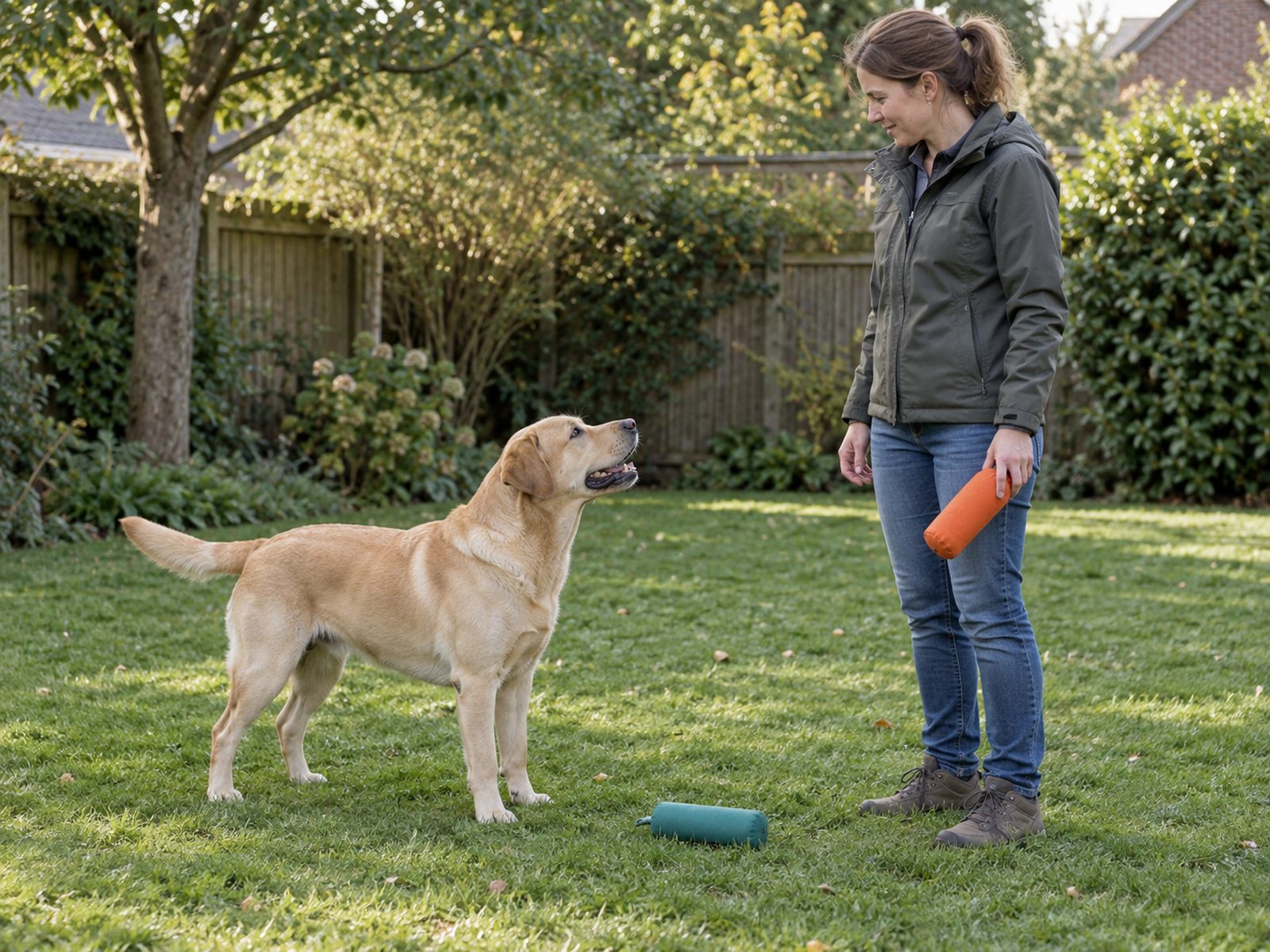
A Household Object Map for Practice and Prevention
Use this editorial worksheet to decide what belongs in a training session and what belongs behind a door. It is a household planning aid, not a validated behavior assessment. Walk through your rooms without the dog and fill in the last column with an actual person’s name or storage location.
| Location and object | Planned action | Detail to agree at home |
|---|---|---|
| Living room: intact dog toy | Use for an easy, supervised exchange | Which toy, cue, and reward will adults use? |
| Laundry area: socks and underwear | Prevent access; do not plant them as practice bait | Who closes the hamper or laundry door? |
| Kitchen: food packaging and scraps | Store rubbish securely | Where does waste go during meal preparation? |
| Child’s play area: small toys | Separate dog access from play and cleanup | Which adult checks the floor before the dog returns? |
| Bag or bedside table: medication | Store securely out of reach | Is the visitor’s bag also protected? |
| Garden: damaged toys or unfamiliar debris | Inspect before a play session | Where will discarded pieces be put? |
The practical distinction is access. A dog who can rehearse with its own toy need not rehearse with a sock. Before improving the cue, fix the easiest environmental gap: perhaps it is a lid that does not latch or a bag routinely left open on the floor.
For example, a fictional household might assign laundry checks to the person starting the washing machine and toy cleanup to the adult supervising children’s play. If each assumes the other has done it, the checklist has found a care-handoff problem. Another successful toy trade will not close that gap.
Record the Part That Is Difficult
Use one line per session: setting / object / reward visible or hidden / release / collection / body language. This is an observation log, not a pass-fail score. A dog might release promptly but hesitate when a hand reaches down; another may trade indoors and struggle on the patio.
| What you notice | A useful next adjustment |
|---|---|
| Drops only when food appears | Keep the easy setup and practice cue-before-reward timing |
| Immediately takes the toy again | Work on release separately; avoid racing to collect it |
| Runs off during practice | Stop chasing; reset later in a quieter, manageable space |
| Stops responding during excited play | Pause the game and make the next session calmer |
| Becomes tense when approached | End practice and seek individual professional guidance |
Change one detail at a time. Moving outside, choosing a favorite toy, and adding a second person together leaves you little idea which change mattered. A simple log also gives a qualified trainer something concrete to review if progress stalls.
When the Problem Is Guarding or Swallowing
Dogs Trust’s resource-guarding guidance describes warning behavior and the importance of professional support. Freezing over an object, a hard stare, growling, or snapping should end an ordinary home lesson. Give space, keep others away, and contact your veterinarian and a qualified behavior professional. Sudden changes also warrant a health assessment. Do not test whether a better treat will let you take a guarded item.
If an object may already have been swallowed, call your veterinarian promptly instead of continuing cue practice. Cornell’s foreign-body guidance explains that obstructions can be emergencies; signs can include vomiting, appetite loss, abdominal pain, and lethargy. Do not wait for those signs before asking about a suspected ingestion. Breathing difficulty or collapse requires emergency veterinary care.
For non-emergency training, choose a professional who explains their reward-based methods. AVSAB’s humane training position statement supports reward-based training and advises against aversive methods. A plan based on frightening the dog or forcing its jaws apart does not belong in this exercise.
Pros and Cons of Practicing Toy Trades
| Benefits | Limits and commitments |
|---|---|
| Gives adults a clear play routine | Everyone needs to use the same meaning for the cue |
| Makes reward timing easy to observe | Food or suitable alternative rewards need preparation |
| Lets you separate release from collection | A living-room success does not establish outdoor reliability |
| Creates useful notes for a trainer | Home practice does not replace help for guarding or biting |
This approach suits an adult-led household whose dog is comfortable around possessions. It is unsuitable as a do-it-yourself test for a dog with bite risk, or as a child’s job when a dog takes a toy. Ask for professional support before rehearsing exchanges in those circumstances.
Allow for classes or individual support in the Dog Cost Calculator. If you are choosing a dog, use the Dog Fit Score Cards to discuss whether the household can provide daily practice and management. Neither tool predicts an individual dog’s guarding risk.
Make the Next Exchange Easy
A useful drop-it habit starts with an easy exchange and a household that makes the same sensible choices around objects. Choose one safe toy, note what happens at release and collection, and put the laundry away. When discomfort or danger enters the picture, stop treating it as an ordinary training repetition and get the right help.