
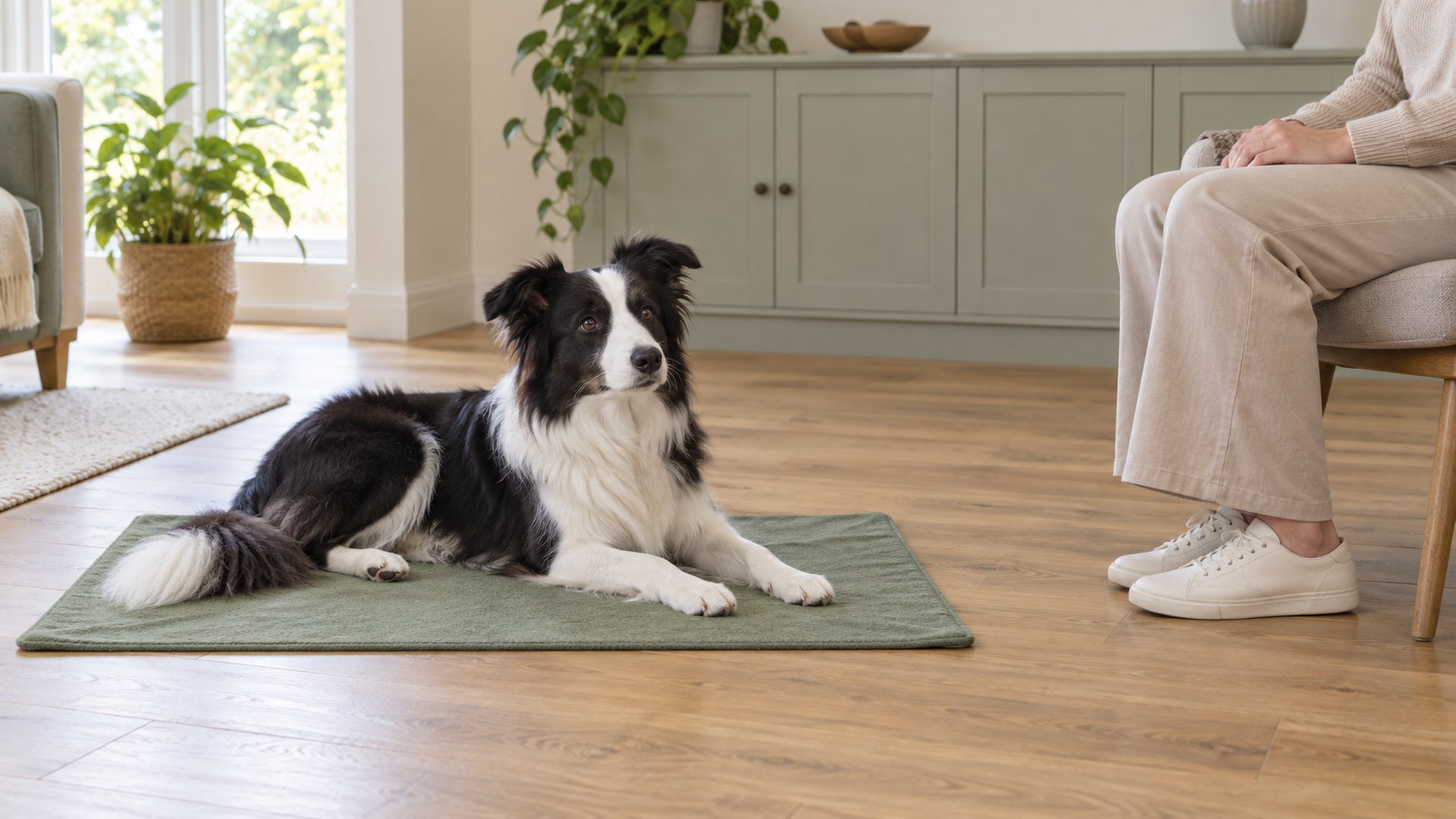
To teach your dog to settle on a mat, start in a quiet room, reward comfortable voluntary behavior, and add everyday distractions gradually. Picture the moment you sit down with a book and your dog arrives carrying a ball. A familiar resting spot can help you build a quieter routine together, provided the dog has had its needs met and feels comfortable there.
The useful goal is a dog who can rest beside ordinary household life. This guide explains how to begin, how to make practice easier when it stalls, and how to decide whether you need professional help. It does not promise that a mat will solve every reason a dog struggles to relax.
Mat Training Quick Facts
| Question | Practical starting point |
|---|---|
| What are you teaching? | Going to a comfortable resting spot and spending quiet time there |
| Where should you begin? | A familiar room with little movement and somewhere for you to sit |
| What equipment is needed? | A stable, comfortable mat and small food rewards your dog can eat safely |
| How should practice feel? | Brief, easy, and calm enough that the dog can disengage |
| What counts as progress? | Comfortable posture in the current setting, followed by small increases in difficulty |
| When should you pause? | Distress, repeated frustration, or difficulty getting comfortable |
Check the Dog and the Room Before Asking for Quiet
Choose a moment when toileting, water, appropriate activity, and companionship have been addressed. Put the mat where the dog can stretch out without blocking a doorway. A spot beside your chair is easier to supervise than a corner behind the sofa. Check that the surface stays put when paws land on it.
For a first attempt, you should be free to pay attention. The start of an important work call is a poor rehearsal: if the dog gets up, you cannot easily adjust the exercise. Try the same chair during a quiet break instead. Keep other pets away from the training food and leave the dog a clear way to move away.
The RSPCA’s training advice recommends brief, regular practice with limited distractions. A few manageable repetitions are a sensible starting point. There is no need to buy a specialist raised bed, a remote feeder, or a collection of branded training aids before trying the skill.
Stillness and Relaxation Are Different Things
A dog may hold a down position while watching your hand intently. That can be a useful learned action, but it tells you little on its own about rest. Look at the whole dog: posture, face, movement, and what is happening nearby.
Dogs Trust’s body-language guide describes relaxed muscles and a loose body, sometimes with the head resting near the paws. Interpret these alongside the situation; one photograph or a wagging tail cannot establish how a dog feels. If the body becomes stiff or the dog repeatedly tries to leave, reduce the pressure.
For your notes, use observations such as “looked toward the hallway, then put head down.” Avoid turning the exercise into a contest to remain motionless. Repositioning to get comfortable is compatible with resting.
Build the Mat Habit in Small Steps
There are two useful parts: learning where the mat is, and learning to relax there. Battersea’s mat exercise develops the first through gradual rewards for approaching, stepping onto, and lying on the mat.
- Let the dog investigate. Place a reward on the mat for voluntary interest. Give the dog room to approach.
- Build comfortable contact. Reward paws on the surface, progressing toward standing on it without hesitation.
- Invite lying down. If a comfortable down is already familiar, you can ask for it. Otherwise, reward a voluntary lie-down or get help teaching that separate skill. Do not press the dog into position.
- Make the pause easy. Reward briefly remaining comfortable before increasing the wait by a small amount.
For the relaxation part, Dogs Trust’s settle exercise emphasizes quiet rewards for increasingly relaxed behavior, including shifting weight or resting the head. Deliver food calmly near the dog instead of drawing it up toward your face. Avoid constant chatter that makes every pause another interaction.
Once the dog is comfortable, gradually extend the interval between rewards. Keep some easier pauses in the mix. If the dog rises, make the next attempt simpler. End while practice is going well and allow the dog to leave; resting should remain comfortable.
A word such as “mat” can eventually signal where to go. Voluntary settling without a spoken instruction is valuable too. Everyone in the household should agree whether they are practicing a destination cue or quietly rewarding rest, so the dog is not hearing several competing instructions.
A Household Distraction Ladder You Can Save
The table below is an illustrative practice plan, not a tested timetable or a requirement to finish in a week. Its purpose is to separate three things owners often change together: how long they wait, how far they move, and what else is happening.
| Everyday goal | Small rehearsal | Keep easy at first | If the dog gets up repeatedly |
|---|---|---|---|
| Read in your chair | Lift a closed book, then put it down | Stay seated beside the mat | Move only your hand; save page turning for later |
| Use your laptop | Place the closed laptop on your knees | No call, alerts, or keyboard noise | Practice with an ordinary notebook first |
| Stand to stretch | Shift forward in the chair, then sit back | Keep the pause between rewards short | Rehearse a smaller weight shift |
| Have someone pass through | A familiar adult takes one step at a distance | One person, no greeting | Add distance or return to practicing alone |
| Move to another room | Put the familiar mat beside a chair there | Start with the easiest version again | Return to the original room and reassess the new location |
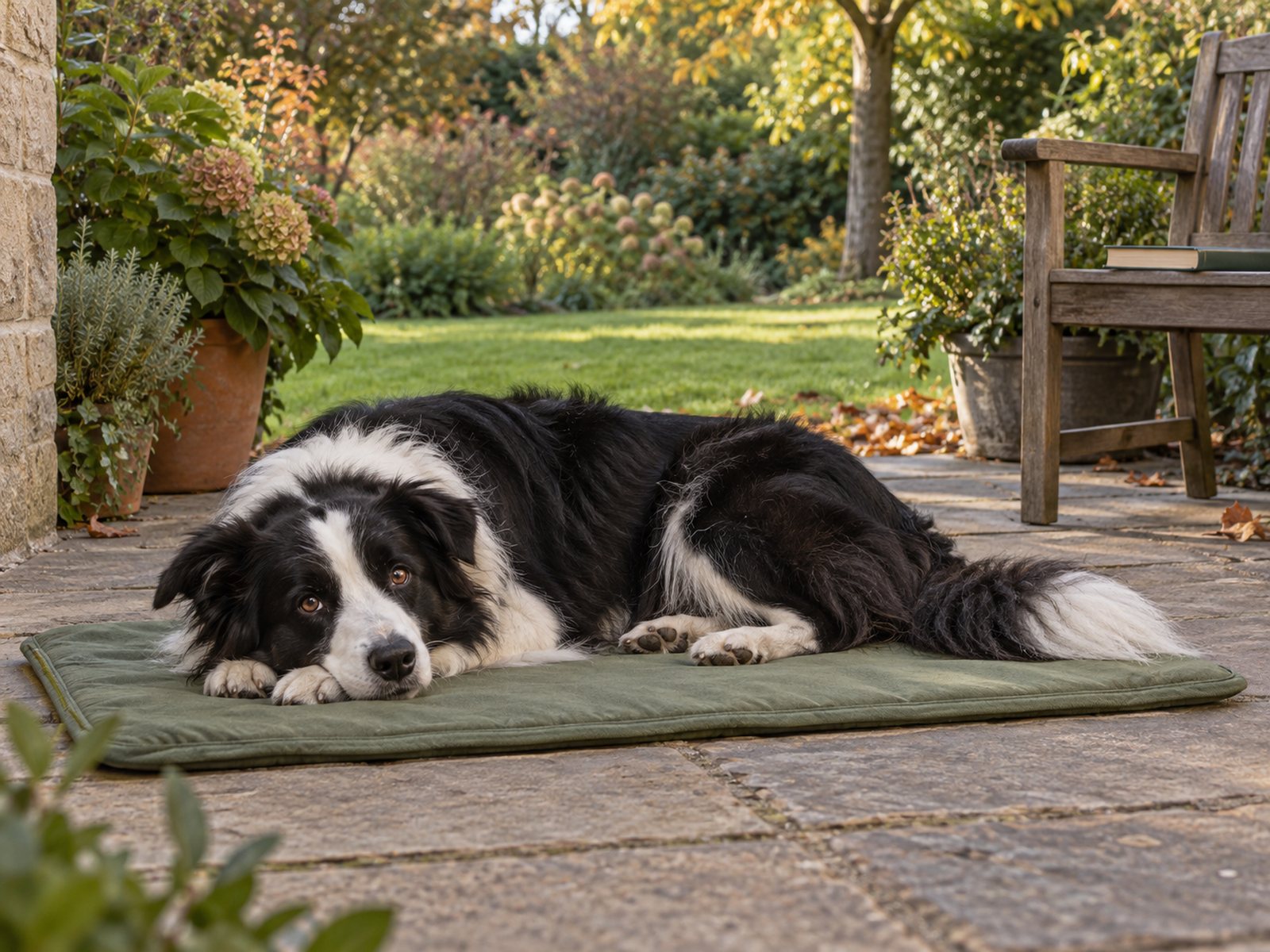
| Read on a private patio | Sit outside briefly during a quiet period | Mild weather, no visitors, secure space | Go indoors if sounds or movement prevent rest |
Choose the row that serves your household. A person who works at a desk may benefit more from quiet keyboard practice than from preparing for a cafe. Write down what you changed before deciding to increase difficulty again.
For example: “Tuesday, living room, I stayed seated and turned one page; dog glanced up and rested again.” That note gives tomorrow’s practice a starting point. “Tuesday, failed to settle” does not explain whether the problem was a longer wait, a moving person, or a new location.
Do not use a real delivery, running children, or a crowded gathering as an early test. Keep a separate management plan for those moments. A familiar mat is a training aid; it does not physically prevent an escape or an unsafe greeting.
When the Dog Stares, Barks, or Keeps Getting Up
The dog watches the food constantly
Check whether you are holding the reward in view or repeatedly reaching into a noisy bag. VCA’s teaching-calm guidance recommends rewards that interest the dog without producing excessive excitement, and gradually rewarding more relaxed postures. Quiet delivery matters too.
Try preparing a few small rewards before sitting down. If the dog can only stare and wait tensely, simplify the exercise or stop for now. Do not stretch the wait indefinitely in the hope of forcing relaxation.
The dog leaves when you move
Your movement may be harder than the waiting itself. VCA separates settling near the owner from moving to a mat farther away. Use that distinction: remain close while introducing a small movement, or stay still while practicing slightly farther away. Save combining both changes for later.
Barking or frustration keeps increasing
Check needs and remove the difficult distraction. A mat session can end without a final performance. The AVSAB humane training statement supports reward-based methods and addressing the conditions driving unwanted behavior. Shouting, leash corrections, or holding a dog down add pressure to an exercise intended to support calm.
If repeated attempts leave either of you frustrated, a qualified reward-based trainer can watch the setup and help identify what to change. Tell them exactly when the barking starts, rather than asking only for a longer stay.
Pros and Cons of Using a Mat for Quiet Time
| Advantages | Limits and trade-offs |
|---|---|
| Gives the household a clear place to practice rest | Requires people to protect that space from interruptions |
| Uses equipment many owners already have | Surface, location, and comfort still need checking |
| Can be practiced around a specific daily activity | Learning beside a chair does not establish readiness for a busy public place |
| Offers a repeatable way to observe progress | Can become another demanding task if owners focus only on duration |
Choose a mat that is easy to clean and suitable for your dog’s size. If the dog chews or swallows fabric, stop using that material and ask for advice about a safer setup. Keep food rewards within the dog’s daily feeding plan; consult your veterinarian about dietary restrictions.
Who This Practice Fits and When to Get Help
This is a useful household skill for owners who can arrange short, calm practice and respond to their dog’s comfort. It can complement daily care for active dogs; our Border Collie guide and Australian Cattle Dog guide discuss why activity and downtime both deserve planning.
It is a poor stand-alone answer for panic during absences, biting, guarding a resting place, or unexplained pacing. Cornell’s pain-recognition guidance lists restlessness, trouble getting up, and altered sleep among possible signs of discomfort. Contact your veterinarian about a new inability to settle, especially with other changes. Videos and brief notes can help the consultation. Seek qualified behavior support for fear, guarding, or aggression; avoid deliberately triggering the behavior to test your training.
If you are still choosing a dog, use the Dog Fit Score Cards to compare your available time and household demands. Put training support and backup care into the Dog Cost Calculator. Neither tool can predict an individual dog’s ability to relax.
Start With One Quiet Moment
Choose a chair, a comfortable mat, and one everyday activity you would like to share peacefully. Begin with an easy version while you have time to watch the dog. Record what happened, then repeat or adjust it. The worthwhile result is a routine that makes rest easier for both of you, with enough flexibility to meet the dog’s needs when the day changes.