
A Beagle may suit a household that enjoys active, scent-led outings and can manage a sociable hound’s voice and curiosity. A Dachshund may suit someone who wants a smaller hound and can give careful thought to handling, furniture access, and back-health planning. Neither is a shortcut to an undemanding dog. In a Beagle vs Dachshund decision, the useful comparison starts where the lead hangs and the stairs begin.

Beagle vs Dachshund Quick Facts
| Household question | Beagle | Dachshund |
|---|---|---|
| What size am I comparing? | US varieties are up to 13 inches or over 13 to 15 inches at the shoulder | Miniature and standard sizes; ask which one you are meeting |
| What shapes outdoor time? | Following scents, secure handling, and an active routine | Regular walks and exploration suited to the dog’s build and health |
| Is a short coat easy? | Short double coat, with shedding and brushing | Smooth, longhaired, or wirehaired coats have different upkeep |
| What about noise? | Barking and baying can matter to neighbors | Alert barking can matter even in a small dog |
| What deserves extra planning? | Containment, companionship, and time to sniff | Stairs, furniture, handling, and veterinary discussion of spinal risk |
| Is there a guaranteed easier choice? | No; meet the individual and examine your schedule | No; smaller stature does not settle the care question |
The physical and care distinctions above draw on AKC’s Beagle profile and Dachshund profile. They describe tendencies, not a prediction for a particular puppy or adult.
Compare the Actual Size and Coat Before Comparing Convenience
“Dachshund” can mean quite different dogs to two people. Under the US breed standard, the miniature classification is 11 pounds and under at 12 months or older; a standard usually weighs 16 to 32 pounds. Those are breed descriptions, not a target weight for every individual. A standard Dachshund may overlap a Beagle in weight even though its outline is much lower.
Ask for the adult dog’s measured weight and height. For a puppy, discuss the parents and expected growth without treating an estimate as a promise. Check whether your transport arrangement, carrying ability, and housing rules still work at the larger end of the estimate.
Coat choice also changes the comparison. AKC describes the Beagle’s short double coat as shedding through the year. It identifies greater grooming demands for longhaired and wirehaired Dachshunds than for smooth ones. Before budgeting, show a groomer the specific coat and ask what care belongs at home and what might need an appointment. A photo of a smooth Dachshund cannot price the upkeep of a wirehaired one.
For broader background, keep our Beagle guide and Dachshund guide beside this comparison. Here, the aim is to choose between the two, rather than repeat each full breed profile.
Walk the Route You Would Use on a Busy Morning
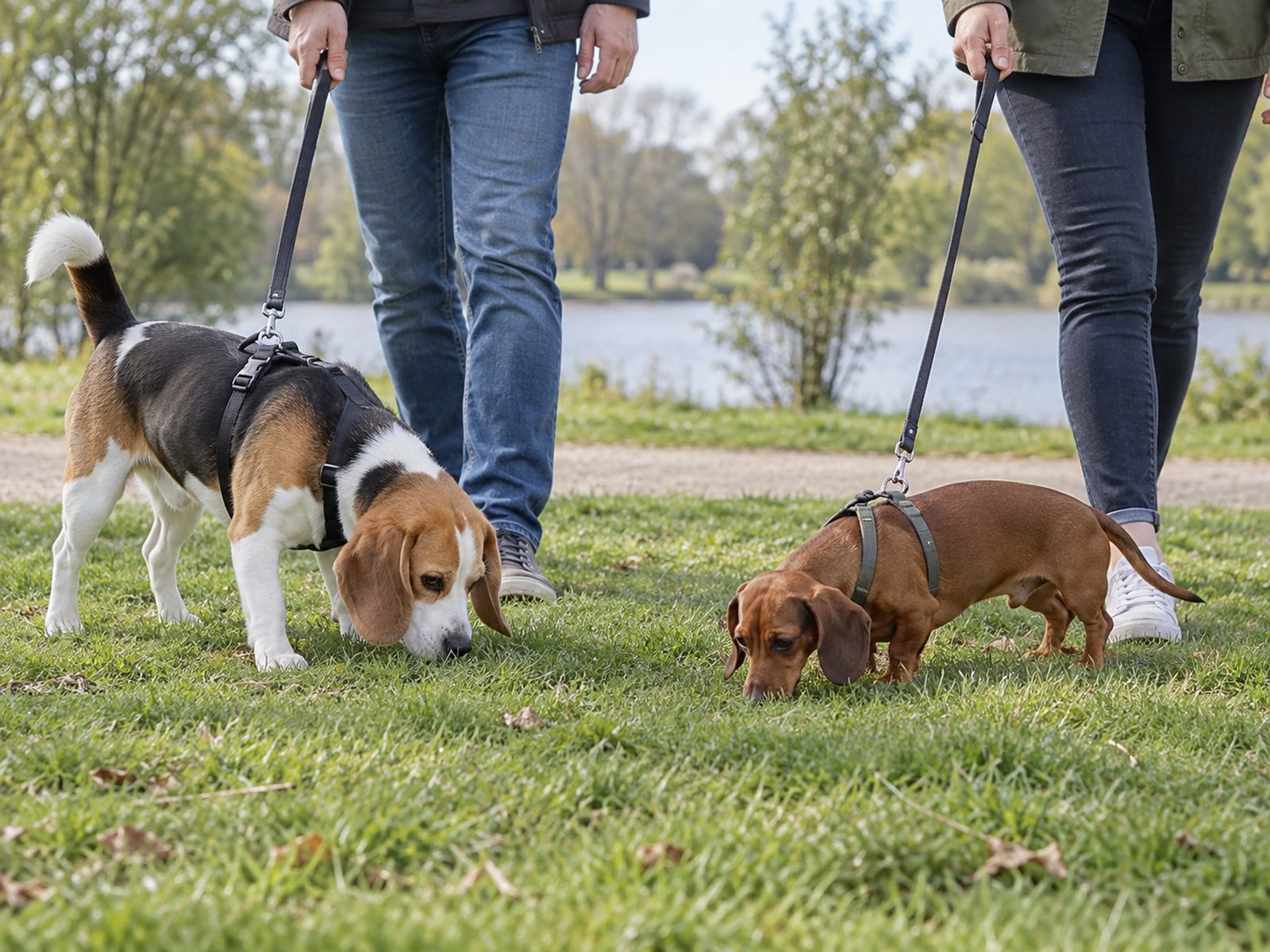
The National Beagle Club’s owner overview emphasizes the breed’s tendency to follow scent and the importance of secure containment and lead walks. It also acknowledges that owners without a fenced yard can meet exercise needs through diligent walking. A garden is useful only if its boundaries and daily use work for the dog.
Walk your proposed route before making a decision. Notice exits into traffic, gates other people leave open, narrow passing places, and somewhere you could stop without blocking the pavement. If you dislike pausing while a dog investigates a verge, think carefully about how much you would enjoy daily life with a scent hound.
A Dachshund also needs an active life. The Dachshund Club of America’s care guidance recommends a daily pattern of lead walks and play, adjusted to age and condition. Short legs do not justify skipping exercise. Discuss suitable activity with a veterinarian, particularly for a puppy, older dog, or dog with a medical history.
Ask the current carer to describe a normal outing: where the dog walks, how it responds to distractions, and what makes an outing difficult. Observe with their help. Do not test recall by unclipping a lead in an open place, and do not use a single energetic visit to prescribe a lifetime exercise schedule.
A Hound-Specific Decision Table for Your Address
This is an original planning worksheet, not a scientific breed score. Fill the last column before choosing. An unanswered question is useful information; do not turn it into a point for whichever dog you already prefer.
| Constraint at home | Beagle question | Dachshund question | Evidence to collect |
|---|---|---|---|
| Shared walls and a busy hallway | What is known about baying, visitors, and time alone? | What is known about alert barking near doors and windows? | Carer’s observations in a similar setting, plus your building’s rules |
| Stairs between bed and outdoors | Could you manage this dog’s actual weight if assistance were needed? | Can you provide an activity and access plan agreed with your vet? | Photos of the route and the person responsible for each outing |
| An unfenced outdoor area | Can every outing be securely handled? | Can exploration stay secure without depending on recall? | A usable walk route and an adult available to take it |
| Young children at home | Is an active puppy realistic alongside their needs? | Can adults manage handling and keep interactions comfortable? | A rescue or breeder assessment and a supervision plan |
| Paid help during work | Will the walker allow time for the dog’s style of outing? | Can the walker follow handling and access instructions? | Confirmation from the provider about the actual dog |
| A fixed grooming budget | Have you included regular home care? | Which coat type did the quote cover? | A written care routine and any local service quote |
Consider a hypothetical third-floor flat with no lift, a shared corridor, and a midday walker. The miniature Dachshund is smaller, but that alone does not answer who manages every trip downstairs. The Beagle’s different build does not answer the noise question. Both remain uncertain choices until the access plan, carer’s observations, and walk arrangements are clear.
Save the completed table with your adoption notes. Bring the unresolved row to the person who can answer it: the dog’s carer, building manager, service provider, veterinarian, or qualified trainer. That is more useful than adding another breed-ranking score.
Noise and Training: Ask for Examples, Not an Obedience Label
Neither breed is a safe bet when silence is essential. The Beagle club flags barking and the difficulties that can follow too much time alone. AKC describes Dachshunds as vocal, vigilant dogs. These descriptions do not establish which of two individuals will disturb your neighbors more.
Ask what happens when a parcel arrives, when another dog passes, and when the household leaves. Separate an observed behavior from a guess: “barked at the door during our visit” tells you something; “will be quiet once settled” leaves the question open. If distress or persistent barking is present, consult a veterinarian or qualified trainer about the cause and a suitable plan.
Both AKC profiles recommend patient, reward-based teaching. Start with skills your home requires, such as responding to a name indoors, walking comfortably on a lead, and resting while people are busy. Our mat-settling guide offers one practical starting point. Training progress in a quiet room does not establish reliability beside an interesting smell.
For a first dog, ask who will teach you as well as who will teach the dog. Find out what support the rescue or breeder provides and whether a qualified trainer can help with your particular constraints. Choosing either hound on a promise of effortless obedience sets an unhelpful expectation.
Back Health Changes the Questions, Not Just the Equipment List
Spinal health deserves explicit discussion before choosing a Dachshund. It also belongs in a Beagle’s health conversation: Cornell lists both breeds among those predisposed to CDDY-related disc disease. That does not mean their risks are identical, or that either individual will develop it. Genetics, health history, and other factors matter.
Ask a veterinarian about appropriate activity, body condition, lifting, and the actual stairs and furniture in your home. Cornell’s IVDD overview advises sensible activity and reducing repeated stair use and furniture jumping. Ramps or access changes may form part of a plan; buying them does not guarantee prevention. Avoid choosing an inactive life for a healthy dog out of fear.
Request available health records and discuss any family history of back or neurological problems. If pain, wobbliness, or dragging paws appears, contact a veterinarian promptly. Sudden loss of the ability to stand or walk needs emergency veterinary attention. Do not use an online comparison to diagnose the cause or decide on treatment.
Pros and Cons: What Each Choice Asks You to Accept
| Option | Potential advantage for the right household | Trade-off to accept |
|---|---|---|
| Beagle | An active companion for people who enjoy scent-led outings | Secure handling, noise awareness, and a dependable companionship plan |
| Smooth Dachshund | A compact hound with comparatively straightforward coat care | An active mind, possible alert barking, and careful access and handling decisions |
| Longhaired or wirehaired Dachshund | Other coat options within the breed | A coat-specific grooming commitment alongside the same household questions |
| Neither, for now | Time to resolve a difficult constraint before taking responsibility | Waiting or widening the search instead of choosing by appearance |
A Beagle deserves a closer look when you want to spend time outdoors with an interested nose and can support the dog between outings. A Dachshund deserves a closer look when its size and personality appeal and the household can sustain the care plan. Neither is a good default for someone who requires low noise, instant recall, or a dog whose needs disappear during work hours.
Price Two Real Care Plans Before Choosing
Run separate estimates in the Dog Cost Calculator. Replace assumptions with local quotes for routine care, grooming, training, and paid walks. Ask providers about the exact size, coat, access route, and health needs involved. A small food bill does not answer the whole affordability question.
Use the Dog Fit Score Cards to keep care differences visible, then return to your completed household table. Choose the dog whose needs you can support on an inconvenient weekday, with help arranged where needed. If the deciding answer is still “we will work that out later,” take that question to the dog’s carer before arranging collection.