
Dog grooming costs are easier to plan when you price a full year of care: the agreed service, the number of appointments, home supplies, and the trips to get there. A price for one haircut leaves most of that picture unfinished. Before choosing a dog or a new coat style, ask a local groomer what maintaining it would involve between visits.
The small curly dog beside the sofa may need a modest food bowl and a surprisingly busy appointment calendar. This guide helps you turn a quote into a workable annual budget. It does not offer a national price average: the dollar amounts below are deliberately fictional, so you can see the calculation and replace every input with your own.
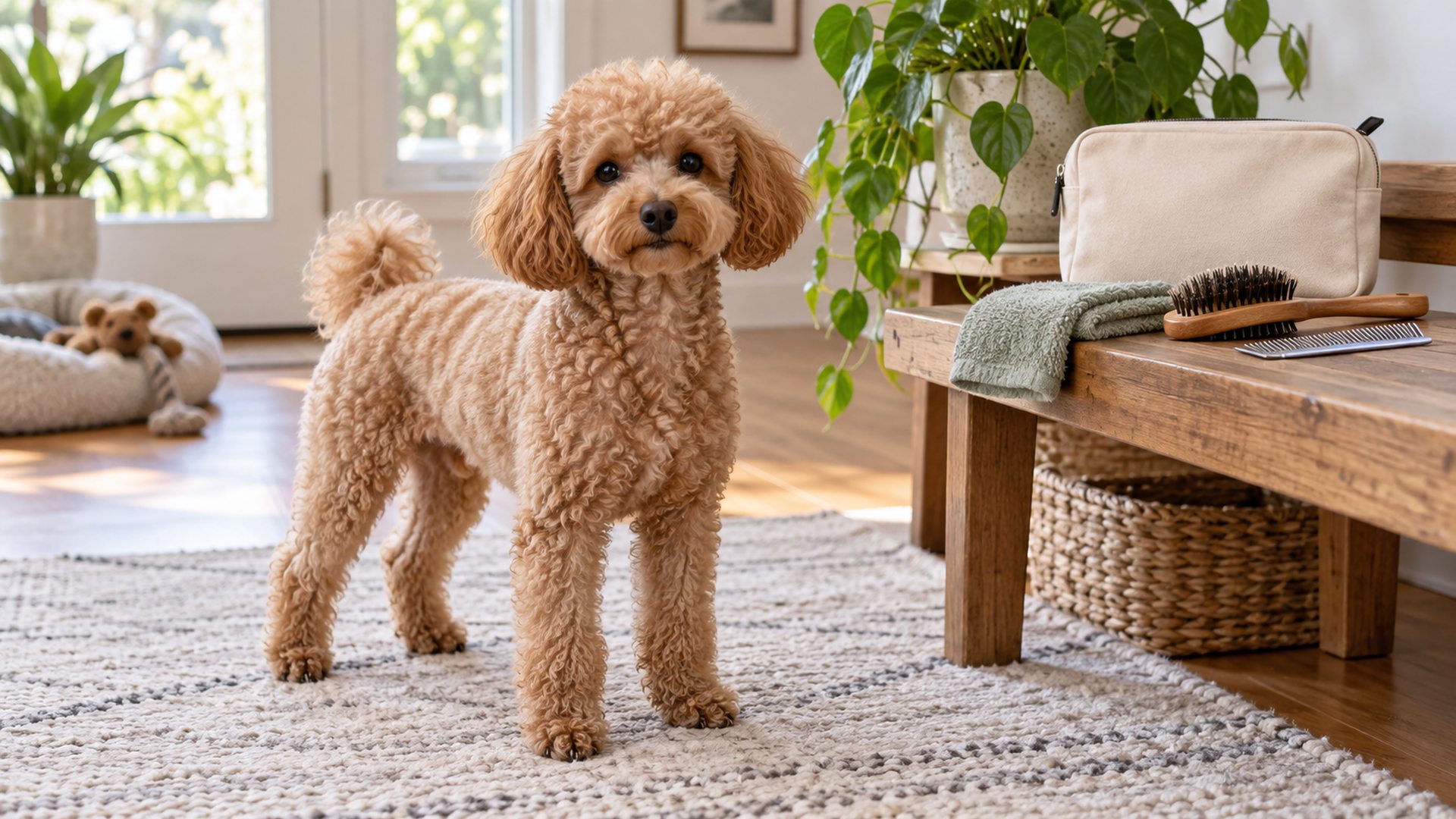
Dog Grooming Budget Quick Facts
| Budget item | What to write down |
|---|---|
| Appointment price | Quote for the adult dog’s size, coat condition, and chosen service |
| Repeat interval | Schedule agreed with the groomer for that individual coat |
| Home maintenance | Tools, replacement supplies, and who does the work |
| Travel | Cost and time for both drop-off and collection |
| Unplanned care | A separate allowance, plus access to suitable professional help |
| Veterinary needs | A separate budget; a grooming visit does not replace medical care |
The AKC’s professional grooming guide describes frequency as dependent on factors including coat, lifestyle, and requested trim. Ask for an individual recommendation before assigning an interval. Choosing the cheapest row in a spreadsheet cannot establish what the dog’s coat can comfortably tolerate.
Turn the Appointment Interval Into a Yearly Number
Start with this planning calculation:
Annual grooming plan = appointment price × planned visits + home supplies + travel + a grooming contingency.
For a rough repeating schedule, divide 52 weeks by the interval and round up to a whole visit. Then check actual dates. A calendar year can contain a different count depending on the first appointment; a new puppy’s introductory visits may also need a separate plan. Rounding is a budgeting convenience, not a prescribed grooming schedule.
Here is a fictional example using US$80 per appointment. These intervals are arithmetic scenarios, not recommendations for particular breeds. Supplies, transport, taxes, tips, and additional services are excluded from this first table.
| Hypothetical interval | 52 ÷ interval | Rounded planning visits | Appointment allowance | Monthly amount to set aside |
|---|---|---|---|---|
| Every 4 weeks | 13 | 13 | $1,040 | $86.67 |
| Every 6 weeks | About 8.7 | 9 | $720 | $60.00 |
| Every 8 weeks | 6.5 | 7 | $560 | $46.67 |
Four-weekly is not the same as monthly: monthly means 12 appointments, while a repeating four-week schedule averages 13 over 52 weeks. That difference is easy to miss when comparing two apparently similar quotes.
Now expand the six-week example. Suppose the fictional household allows $720 for visits, $60 for supplies, $10 travel per visit, and $80 for an additional grooming need. Its total is $950 per year, or $79.17 per month, rounded to the nearest cent. None of those inputs is a market estimate or a recommended emergency reserve. Replace them with your own numbers, and keep veterinary contingencies separate.
An annual average also does not pay the first bill. If the first appointment is next week and your grooming fund starts empty, put aside the full amount due now; use the monthly figure to plan later visits. Write down any deposit and whether it is credited toward the final bill so you do not count it twice.
Compare the Service, Not Just the Starting Price
Two shops can give different prices because they are describing different work. Send each the same useful information: adult or expected adult size, coat type, desired style, recent grooming history, and any difficulty with handling. A photo can help the conversation, but ask whether a hands-on assessment is needed before the quote becomes firm.
Use this checklist when requesting information. It is a comparison aid, not a claim that every shop charges for every item.
| Ask the groomer | Why the answer changes your plan |
|---|---|
| What does this quote include? | Establish whether bathing, drying, coat work, and nail care are bundled |
| Which services would be extra for this dog? | Record the complete likely visit rather than a headline starting price |
| What home care does this trim require? | Connect the quote to a routine you can maintain |
| When would you reassess the price? | Clarify adult size, coat changes, or a different style |
| What happens if my dog becomes distressed? | Understand breaks, stopping rules, and any follow-up arrangements |
| What are the deposit and cancellation terms? | Plan for a missed workday or transport problem |
| Can you offer the repeat appointments we need? | A suitable service must also be available when needed |
Keep the quote date and currency beside each answer. If one estimate is provisional, mark it that way. Do not compare a fully priced appointment with a minimum advertised fee as though they are equivalent.
A Small Dog Can Have a Large Coat-Care Commitment
Coat work does not shrink in direct proportion to body weight. VCA’s coat-care guidance explains that long, silky, and curly coats need frequent attention to prevent tangling, while short coats may need less brushing. Paying for clipping does not remove the maintenance between appointments.
For a potential Toy Poodle owner, the useful comparison is between the trims you can actually maintain, paired with the professional schedule each requires. For a potential Maltese owner, ask how a longer coat changes the daily combing commitment compared with a practical pet trim. Our Toy Poodle guide and Maltese guide put those coat choices alongside the rest of daily life.
Do not choose an adult maintenance plan from a puppy photograph alone. Ask the breeder, rescue, and groomer what is known about the individual coat and what may change as the dog matures. If that answer is uncertain, leave room to revise the budget instead of promising yourself a low fixed bill.
Pros and Cons of Three Grooming Plans
| Approach | Potential advantage | Commitment or limitation |
|---|---|---|
| Professional appointments plus home upkeep | Skilled help with more demanding work | Repeat bookings and maintenance still need time and money |
| More maintenance at home, with professional support | May reduce some paid services | Requires instruction, equipment, and comfortable handling |
| Maintaining a longer or more elaborate style | Keeps the appearance the owner enjoys | Agree on the additional home workload and service requirements first |
The ASPCA’s cost guidance identifies home brushing and nail care as possible ways to reduce expenses. That page’s cost table is labeled 2021, so we do not use its figures as current grooming prices. Home care is useful when the task is suitable for both the owner and the dog, not simply because an appointment feels expensive.
A supported home routine may suit someone who enjoys patient practice and can obtain instruction. It may be a poor fit when lifting, handling, workspace, or the dog’s reactions make the work difficult. The AKC’s home grooming guidance recommends asking a veterinarian or groomer which tools suit the coat. Get that advice before buying a full kit that duplicates equipment you will not use.
The Missed-Appointment Test
Before settling on a plan, try this fictional household exercise: your regular groomer is unavailable at the next scheduled visit, and the person who usually brushes the dog is away. What happens that week?
Write down four answers:
- The backup person: who can carry out the dog’s familiar home maintenance?
- The professional contact: who can advise on the coat or provide a suitable alternative appointment?
- The available money: what is already set aside if the alternative service or journey costs more?
- The limit: which signs mean you stop home work and seek help?
This is where a cheap-looking plan may prove fragile. If it works only when one person is free and one salon has space, improve the backup arrangement before choosing a demanding coat style. Do not write an extra-long interval into the budget simply to make the total smaller.
The ASPCA’s grooming handout cautions against cutting mats close to the skin with scissors. Tight matting needs professional assessment. Pain, sores, skin irritation, or sudden handling intolerance warrant a veterinarian’s advice. If fear makes routine care difficult, ask your veterinarian and a qualified reward-based trainer about a suitable handling plan; do not make finishing a haircut the immediate goal.
Put Grooming Into the Whole-Dog Budget
Add your local figures to the Dog Cost Calculator, checking what its grooming field already includes before adding anything separately. Count each expense once. Keep food, veterinary care, daytime help, and boarding visible so an appealing grooming quote does not obscure a larger care commitment.
Then use the Dog Fit Score Cards to consider the time side of the decision. A household that dislikes brushing needs to acknowledge that preference before choosing a coat that requires it. Professional appointments cannot fill every gap in daily care.
This worksheet suits prospective owners comparing care routines and current owners reviewing actual bills. It is not a medical grooming plan for a dog with a skin condition. For ordinary washing decisions between appointments, our dog bathing frequency guide covers a different question: when a bath, a smaller cleanup, or veterinary advice is appropriate.
Choose a Routine You Can Keep
Bring a coat photo, a description of your working week, and the annual worksheet to the grooming conversation. Leave with a clear service, a realistic repeat schedule, and a home routine someone has agreed to do. Review the plan after the first few appointments using actual bills and the groomer’s feedback. The useful budget is the one that keeps care affordable and available throughout the year.